

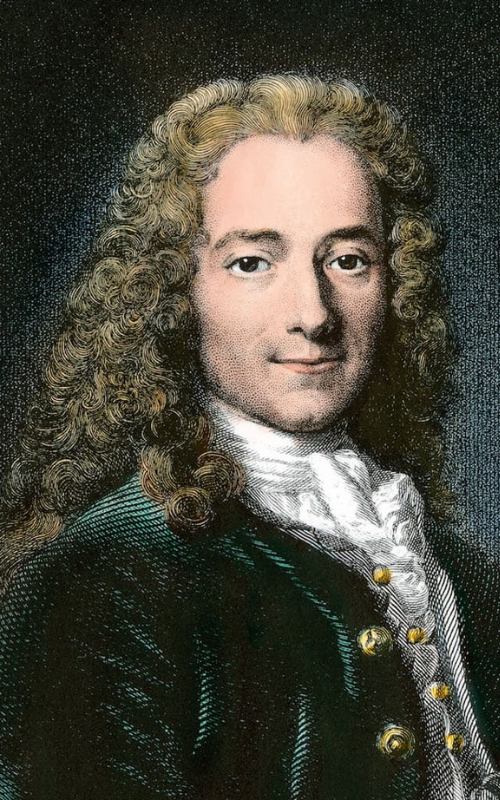
Newton and Voltaire, two guys united by luxuriant hair
Everybody knows the famous story of a falling apple inspiring Isaac Newton to discover the law of gravity. And quite a lot of people know that Newton didn’t actually get bonked with an apple on the head. He just saw one drop and it set him thinking (probably—history is messy).
But the coolest part of the story of gravity is one almost nobody knows, and because history is really weird, it involves FRANCE.
Newton’s Moon Test
When Newton was working on his theory of gravity, he did what any responsible scientist would. He tested his predictions against real measurements. In his case, he tested his theory for how planets applied gravity to each other on data he had from some scientific society. Then Isaac got smacked down by the big old Hammer of Disappointment: the numbers showed that his theory was a bust.
Newton had used figures like the circumference of the earth to calculate its mass and how much gravity he thought it would generate. Then he measured how fast an object fell under gravity and tried to compare that to the moon’s orbit (as affected by the earth). The actual movement of the moon was about 15% different from what he predicted, however.
So Newton did one of the craziest ethical things in all of history: he shrugged and said “I guess I was wrong.” He didn’t fudge the numbers. And just in case you think that sounds normal, Ptolemy did some serious number-fudging that threw off astronomy for thousands of years when he tried to force planetary orbits into these crazy little circles-on-circles-on-circles he called “epicycles.”
I imagine Newton shaking his fist at this guy for years
What’s France got to do with it?
Voltaire (a writer and thinker known for poking fun at religion, society, and anybody else he could irritate) was fascinated by this episode in Newton’s life. Newton knew he was right, so why didn’t he just lie? He could figure out the messy stuff later. Any scientist Voltaire knew would have probably fudged it. But Newton didn’t, and as Voltaire points out in an essay on the subject, it wasn’t Newton’s theory that was wrong. It was somebody else’s numbers.
As Voltaire tells it, Newton used measurements of the earth’s circumference and moon’s orbit from an English scientific publication, and they weren’t accurate. When Newton got better numbers from a French publication, he redid his calculations and discovered he was right all along.
The French scored a point on scientific accuracy, and the whole world scored a lot more with the discovery of the law of gravity.
Newton was ethical and it cost him
He spent years not getting the accolades and accomplishments he was due. It wasn’t even his mistake! It was somebody else’s. But Newton had a code he lived by, and he refused to compromise it.
It’s true that Newton could have published anyway and had things work out too. Plenty of science has been a little rough around the edges in the first draft. But it also could have provoked a backlash when the flaws of his theory came out. And that backlash might have made the theory untouchable for decades, dramatically setting back progress.
Doing something unethical has internal consequences too. I don’t think Newton could have fudged the numbers and remained the man he was.
So why should you care about Newton’s ethics?
Did you notice how I put an asterisk in the title of the blog?
Usually when you see * on a word, it’s someone trying to be a little weaselly. In this case, I wasn’t: being ethical can cost you money, at least in the short run. It may even cost you money in the long run too. Like Newton, I believe it’s worth it, even so.
You shouldn’t need to compromise your ethics to make money. The folks you partner with shouldn’t need to either. Everyone is tempted to take ethical shortcuts. It’s good to be reminded by Newton’s story of the benefits of refusing to.
If you’re working on something big in your business and you need a little help on the vision, getting your team onboard, or persuading the world to buy it, reach out or give us a call. We don’t take ethical shortcuts either.